
 Deutsch
 Türkçe
 Français
 Español
 Portuguese
 Italiano
Hair loss in women is frequently misperceived, which may leave you questioning why. Essentially, this occurs because it lacks the obvious visual markers typically seen in men. Far from a receding hairline or distinct bald spots, women usually face gradual thinning that advances steadily throughout several years.
Because these transformations are so subtle, the Ludwig scale was developed as a vital resource. It provides a more accurate, structured framework to identify and assess hair loss in women, ensuring that these unique patterns are correctly recognized and treated.
The Ludwig scale describes how thinning progresses across the scalp and helps patients and specialists find a common language when discussing the diagnosis and treatment.
In dermatological practice, the 3-grade Ludwig scale remains the standard tool for characterizing the clinical pattern and severity of female pattern hair loss, complementing diagnostic evaluation and management strategies.
Understanding Female Hair Loss
Female hair loss usually begins subtly. Many women will first notice a change in hair volume and texture. It will become noticeably more difficult to create your favorite hairstyle.
Over time, hair thinning becomes more visible, especially around the central scalp and top of the head. The frontal hairline typically remains intact, a key difference from male pattern baldness.
There are different types of hair loss, but female pattern hair loss is by far the most common. Because the process is gradual, it often goes unnoticed until density loss becomes harder to conceal. This slow onset is why structured classification tools are so important in clinical evaluation.
What Is the Ludwig Scale?
The Ludwig scale is one of the most widely used classification systems for tracking female pattern hair loss. Instead of focusing on receding hairlines, which are more common in men, it focuses on hair thinning across the crown and central scalp. The thinner the hair, the later the stage.
For men, the most common way to evaluate the severity of their hair loss is to use the Norwood scale. The Ludwig scale was designed specifically for women’s hair loss patterns.
This framework empowers doctors and hair specialists to measure severity, monitor changes, and assess how hair loss progresses through the years. It offers a structured approach for identifying the difference between temporary shedding and long-term follicle miniaturization.
Wha Are the Stages of the Ludwig Scale?
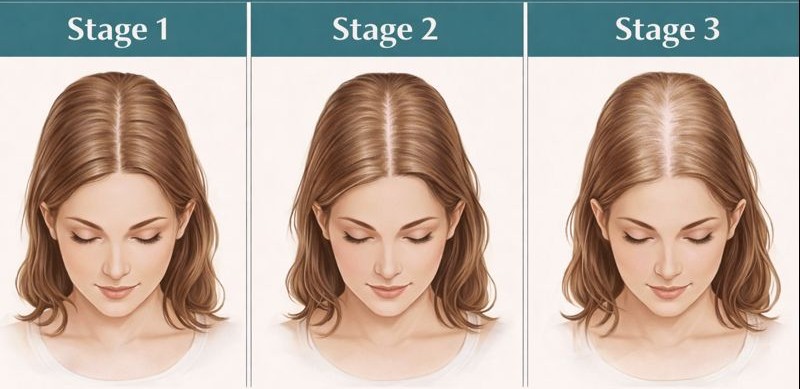
The Ludwig scale is divided into three main stages.
Stage I is characterized by mild thinning along the central hair parting line. It is very tough to notice, and you can only see it under certain lighting conditions.
Stage II shows a wider parting line, and you can see the reduced coverage clearly. Even part of the scalp is clearly visible.
Stage III represents advanced thinning. This is where you can clearly see the scalp with zero visual aids.
All these stages are designed to reflect the natural progression of female hair loss. They help when determining how aggressively to tackle the issue, which type of treatment to go for, etc.
Important Note: Complete baldness for women is extremely rare.
How the Ludwig Scale Helps Diagnose Female Pattern Hair Loss
Using the Ludwig scale allows clinicians to see if the hair thinning is diffuse or localized. They can also see whether hair follicles are still active. This is especially important when evaluating potential balding areas.
Precisely identifying the stage also prevents unnecessary or premature interventions. Evaluating exactly where a patient ranks on the scale and the stages of female pattern hair loss allows specialists to recommend appropriate therapies and establish realistic expectations for density improvement or restoration.
Causes of Female Pattern Hair Loss
The most common underlying cause of female pattern hair loss is Androgenic Alopecia. This is a genetically influenced condition linked to hormonal sensitivity. Unlike sudden shedding disorders, this form of hair loss develops gradually. As follicles become smaller, they produce finer strands.
Reduced hair growth and follicle miniaturization lead to visible thinning rather than complete loss. Aging, hormonal fluctuations, and inherited traits all contribute to this process, which explains why severity and onset vary widely among women.
Treatment Options Based on the Ludwig Stage
Selecting the ideal hair loss treatment relies on the Ludwig stage. During the early stages, care emphasizes preserving existing hair and boosting the patient’s overall scalp health. As thinning progresses, individuals might explore combination therapies to increase hair density.
Potential treatment options span medical therapies, supportive procedures, or surgical solutions, contingent upon follicle activity.
No matter the case, early diagnosis generally allows for more conservative approaches. Later stages, however, require more structured planning.
Here’s a quick comparison table.
Ludwig Stage | Typical Hair Changes | Recommended Approach |
Stage I | Mild thinning | Monitoring and medical care |
Stage II | Visible scalp | Combined therapies |
Stage III | Advanced thinning | Surgical and supportive options |
Hair Transplant Solutions for Women (Without Shaving)
For women with advanced thinning, a hair transplant in turkey can be an effective solution when donor hair quality is sufficient. Multiple modern techniques now permit hair transplantation without shaving the entire scalp.
The procedure prioritizes increasing hair density while blending seamlessly with existing hair. Careful placement ensures natural coverage without altering the original hairline, resulting in a subtle, aesthetically balanced outcome.
Lifestyle And Hair Care Tips to Slow Progression
Medical intervention does play a central role, but daily habits also have an influence. Gentle styling, avoiding excessive tension, and maintaining scalp health will actually support treatment results.
Lifestyle adjustments cannot reverse genetic hair loss, but they will help slow the progression and protect the remaining hair.
When combined with medical guidance, these measures contribute to a more stable long-term outcome.
FAQs
How can I know which Ludwig stage I am in?
A professional scalp examination is the most accurate way to determine your Ludwig stage. Visual self-assessment can be misleading without clinical expertise.
Is a hair transplant suitable for women with Ludwig Scale hair loss?
In selected cases, the answer is yes. Suitability depends on the patient’s donor hair quality, degree of thinning, and overall scalp condition.
Will a hair transplant give natural results in women?
When executed with meticulous planning and technique, hair transplants can deliver natural results that blend smoothly with existing hair.