
How Does a Hair Transplant Work? A Step-by-Step Guide

In this post

If you are going through hair thinning or balding, eventually, you’ll start looking for long-term solutions. If all non-surgical treatments have failed you, then hair transplantation begins to sound like a cool solution. But how does it work? What are the different types? What does the process look like? And, most important of all, what about recovery?

These are all important questions, so let’s try to answer them quickly, with the ultimate goal of helping you set realistic expectations.

Systematic clinical evidence indicates that modern hair transplantation is an effective treatment for male and female pattern hair loss, with techniques like FUE increasingly favored due to reduced scarring and reliable restoration of natural-looking hair.

What Is a Hair Transplant?

A hair transplant in Turkey is defined as a hair restoration procedure that moves (transplants) healthy hair follicles from one part of the scalp to another. The goal is to restore hair coverage in the scalp area where the patient is experiencing hair thinning or balding, using the patient’s own donor hair.

It is a very common solution for patients who are going through male pattern baldness, but there are other applications. It can also be effective for women. The procedure is especially useful for hair loss caused by injury, scarring, or certain medical conditions. Those transplanted follicles tend to retain their original characteristics, which is great news. It improves the chances of getting lasting results.

Types of Hair Transplants

FUE (Follicular Unit Extraction) – A surgeon removes follicular units one by one from the donor area, and then implants them into the thinning or bald area. 

Quick notes: minimally invasive; leaves tiny, dot-shaped scars.

FUT (Follicular Unit Transplantation) – For this type, the surgical team will remove a thin strip of scalp from the donor area and then separate and transplant each follicular unit. 

Quick notes: more invasive; leaves a linear scar; faster (the surgeon can clear a high number of grafts in one session).

DHI (Direct Hair Implantation) – Here we have a variation of the FUE technique where the surgeon implants extracted follicles directly using a specialized tool. 

Quick notes: Allows precise control.

Combined techniques – Surgeons can also combine methods or employ additional methods like scalp reduction to achieve better coverage or density. They can also use additional devices like the tissue expander.

The Hair Transplant Process: Step by Step

  1. Initial Consultation and Hairline Design: The process begins with a consultation. The surgeon evaluates the patient’s hair loss patterns, scalp condition, and the type of hair. A team of experts then designs a hairline based on the patient’s facial proportions and future hair loss expectations.
  2. Preparing the Donor and Recipient Areas: The donor region is typically located at the back or sides of the scalp. This is where hair is genetically resistant to thinning in most cases. The recipient area is then cleaned and marked for implantation.
  3. Follicle Extraction: The surgeon removes individual follicular units from the donor area. Each unit contains one or several hair follicles and surrounding tissue, which is vital to support survival after the procedure.
  4. Graft Preparation: These extracted hair grafts are then carefully prepared and sorted. This step is probably the most important one, as proper handling preserves the follicles and keeps their blood supply constant.
  5. Implantation of Hair Follicles: The prepared grafts are then implanted using tiny incisions in the recipient area. This stage determines the angle, direction, and density. Precision here is key.
  6. Recovery and Aftercare: Patients get detailed aftercare instructions. Mild swelling, redness, or scabbing is very common in early recovery. But most patients return to normal routines fairly quickly. Strenuous activities should be avoided during the initial healing phase.
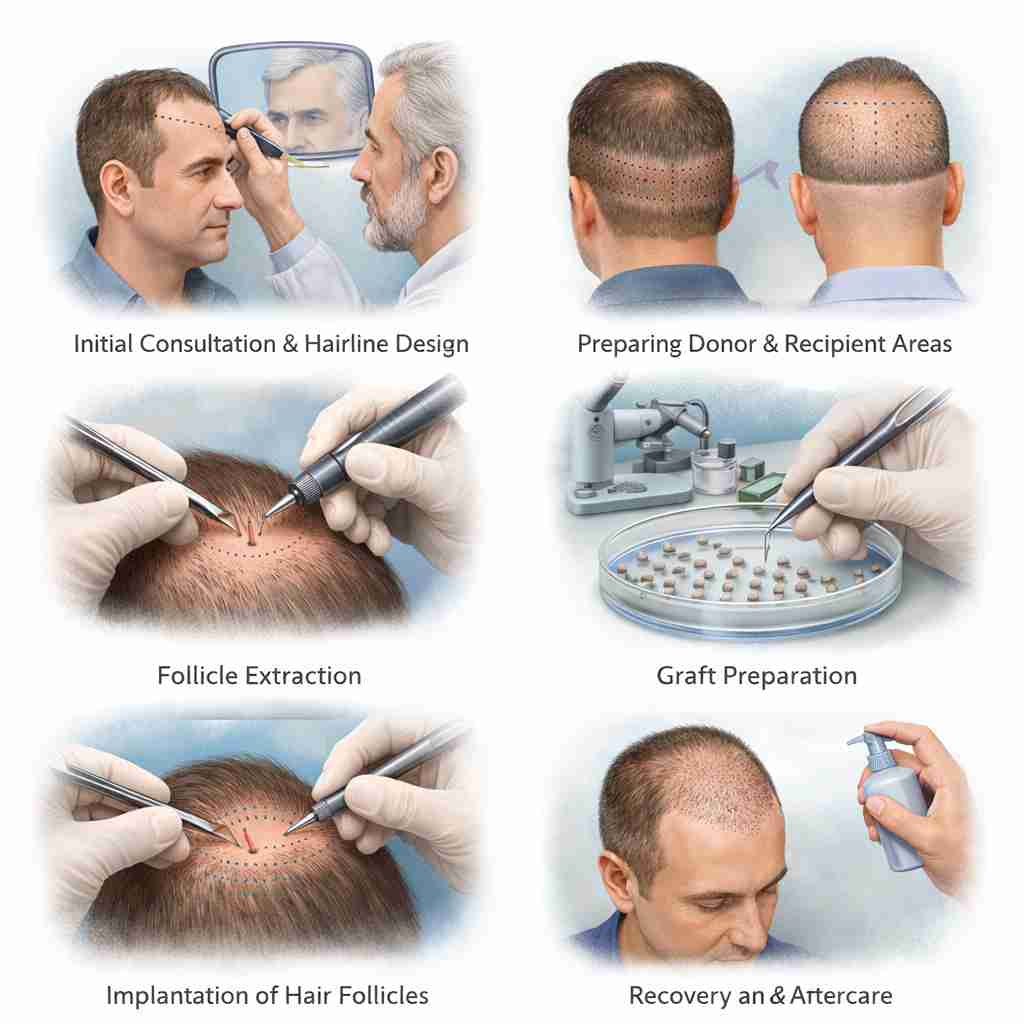

Illustrated step-by-step overview of a hair transplant procedure, showing consultation and hairline design, donor and recipient area preparation, follicle extraction, graft preparation, implantation of hair follicles, and post-treatment recovery care.

How Is Grafting Performed?

Hair grafting means placing each follicular unit into the scalp, and the goal is to mimic natural hair growth patterns. Surgeons need to carefully control the depth and orientation to ensure that transplanted hair mixes with existing hair naturally and seamlessly in the future.

Transplanted follicles usually connect to their new blood supply within days, and over time, they adapt to their new location and behave just like nothing ever happened.

Hair Transplant Recovery & Growth Timeline

Hair transplant results are not instant. Rather, they develop gradually. These transplanted hairs will typically shed within the first few weeks after the surgery, but this is completely normal. 

New hair growth usually begins around three to four months after the procedure. During the following months, hair will continue to thicken and mature. Most patients see noticeable improvement within six months, and the final results become glaringly apparent after 12 months, when they can let their hair grow.

Stage

What Happens

First 2 weeks

Healing, scabbing, mild swelling

1 to 2 months

Temporary shedding of transplanted hair

3 to 4 months

Early regrowth begins

6 to 9 months

Increased density and coverage

12 months

Final result visible

Side Effects and Risks

Of course, there are temporary side effects, and you can experience swelling, redness, itching, or a form of mild discomfort.

More serious complications are rare. With proper planning and careful aftercare, you shouldn’t have anything to worry about. 

Choosing the Right Hair Transplant Clinic

Picking the right clinic is one of the most important decisions on this entire journey. The best advice that anyone can give you is to look for experienced surgeons, transparent consultations, and realistic expectations.

Look for a reputable clinic that focuses on long-term planning. That way, your transplanted hair will continue to look natural for years to come.

FAQs

What is the difference between FUE and FUT, and which is better?

FUE extracts individual follicular units. FUT removes a strip of the scalp. The former is less invasive, but the best option depends on your consultation with a specialist.

If you pick a good clinic, and if the procedure is performed correctly, the results will look natural. 

The answer is yes. A hair transplant is suitable for both men and women. Anyone with enough donor hair who has predictable hair loss patterns is a good candidate.

Since transplanted follicles are resistant to hair loss, the results are generally permanent. With proper care, transplanted hair can last a lifetime.

Let’s Plan Your Hair Transplant Process in 3 Steps

Calculate your rate in less than 2 minutes using its online wizard.

REQUEST FOR A FREE CONSULTATION

EN

"*" indicates required fields

This field is for validation purposes and should be left unchanged.
Name*
This field is hidden when viewing the form