
 Deutsch
 Türkçe
 Français
 Español
 Portuguese
 Italiano
Sun exposure is something people often overlook during recovery after a hair transplant, but it plays a very important role in the healing process. After you finish your hair transplant in Turkey, the scalp becomes sensitive and vulnerable. If your mind is thinking something along the lines of “how long do I need to avoid the Sun after a hair transplant,” the first thing you should learn is that avoiding direct sunlight exposure helps protect all new grafts.
Paying attention to this supports healthy and long term results. So, without further ado, let’s jump in.
Clinical postoperative care guidelines recommend that direct sunlight should be avoided for at least one month after hair transplant surgery to protect the donor and recipient sites and support optimal healing of the grafts.
Why Sun Exposure Matters After a Hair Transplant
After your procedure, as with any surgery, the affected or transplanted area will still be healing. The skin is thinner, more delicate, and it simply isn’t able to defend itself against environmental stress.
Direct sunlight can irritate the scalp and slow down the recovery. Excess heat and UV rays can increase redness, swelling, and give you an overall sense of discomfort. In some cases, sun exposure can actually have a very negative effect on the transplant grafts, which increases the time you need to fully heal by a considerable margin.
For patients who are focused on successful hair restoration, protecting the scalp during the early stages is essential.
How Long Should You Avoid Sun After Hair Transplant?
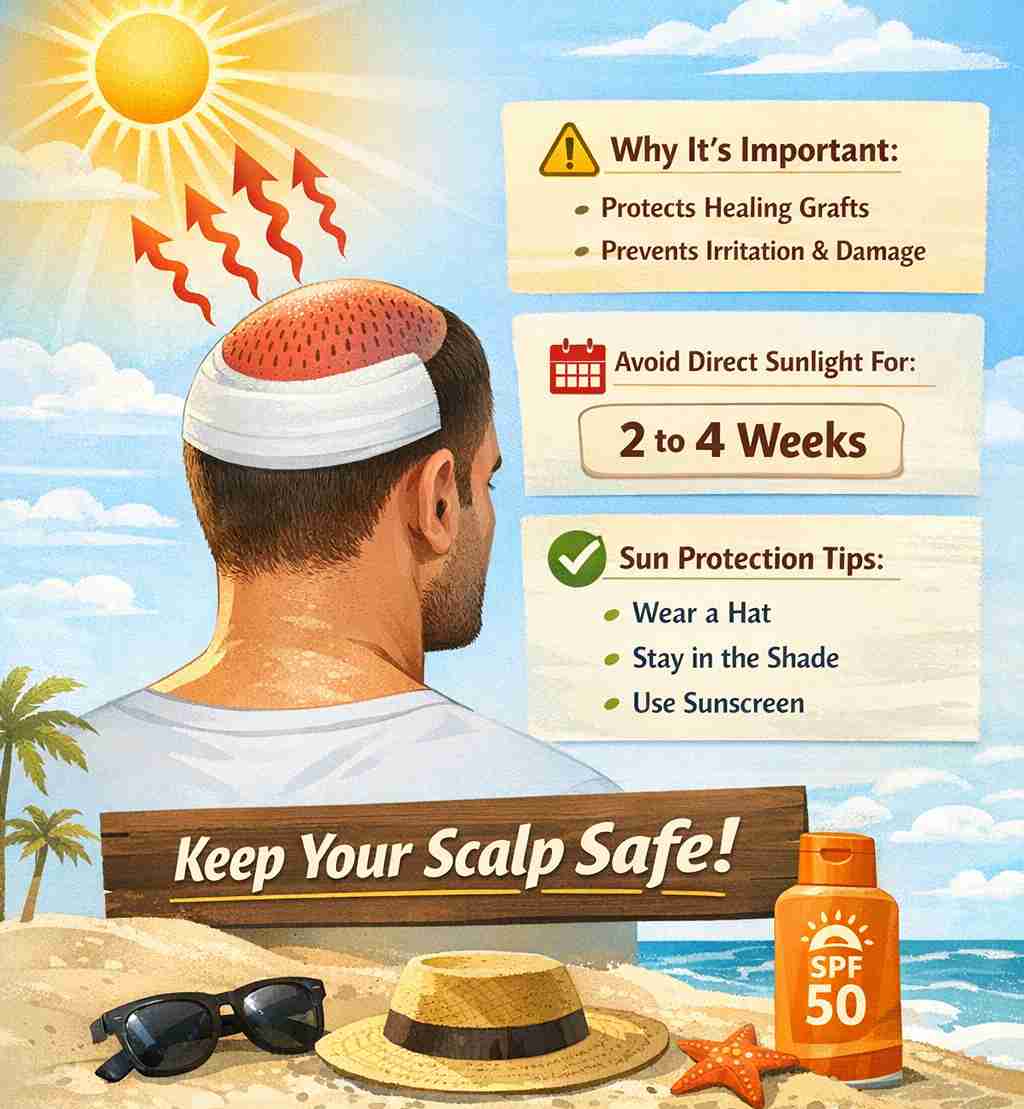
Most specialists will tell you that you should avoid direct sunlight for at least two to four weeks. During this period, the grafts are stabilizing, and the scalp needs time to fully heal.
The first two weeks are especially important. Even short periods of exposure after a hair procedure can irritate the healing skin. After the initial phase, limited exposure is almost always allowed, but only with proper coverage of the transplanted area.
You should drive to protect your scalp for several months, and whenever strong sunlight is expected, take the necessary precautions.
How Does Sun Exposure Affect Hair Transplant Results?
Sunlight affects more than just the surface of the skin. Heat and radiation can increase inflammation and slow the recovery of deeper tissues that support the new follicles.
If the scalp becomes irritated or burned, the healing process will probably be delayed (and quite considerably for that matter). This can affect early hair growth and increase the risk of uneven results. While sun exposure does not directly cause hair loss, repeated irritation can weaken fragile grafts during the recovery process.
Avoiding sun exposure after hair transplant will help you protect the surface and the deeper tissues. All this is done to support long term results.
Effects of UV Rays on Transplanted Hair Follicles
During the early healing phase, transplant grafts rely on a stable blood supply to survive. Strong UV rays can damage the skin barrier and increase sensitivity in the treated area.
Excessive exposure can lead to dryness, redness, or even sun damage. If the scalp becomes inflamed, the grafts will struggle to establish and develop properly. This is why protecting the scalp from the sun is actually an essential part of the recovery process.
Patients who are diligent and follow aftercare instructions carefully usually see smoother healing and more consistent growth.
How to Protect Your Scalp From the Sun After Hair Transplant
In general, there are several simple ways to protect your scalp during recovery. Staying indoors during peak sunlight hours is the safest option for the first few days after the procedure.
Once this initial healing phase is done, patients can go outside with proper protection. A loose-fitting hat is often a good choice to avoid pressure on the new grafts. Tight caps or helmets should be avoided.
After the scalp has healed, you should also apply sunscreen, but only if approved by your doctor. When you know how to use it correctly, sunscreen will help protect the scalp from the sun without irritating the skin.
Can You Go to the Sea or Pool After a Hair Transplant?
Swimming should definitely be avoided during the early recovery period. Saltwater, chlorine, and direct sunlight will (more likely than not) irritate the scalp and slow healing.
Most patients are advised to wait at least three to four weeks before returning to the seaside or their pool of choice. By this time, the skin will have already started to recover, and the grafts will be more stable.
But even after returning to your activities in the water, it is important to protect the scalp from the sun and avoid prolonged exposure.
Is It Safe to Get a Hair Transplant in Summer?
An FUE hair transplant can be performed safely at any time of the year, including the summer. However, the key difference is the level of care required after the procedure.
Patients who are undergoing a hair transplant should do their best to avoid strong sunlight, high heat, and outdoor activities during the early recovery period. With proper planning and protection, seasonal conditions will not affect the probability of the complete success of hair restoration.
Many clinics perform procedures all year-round with consistent results.
Here’s a quick timetable.
Time After Procedure | Recommended Precaution |
First 7–10 days | Stay indoors and avoid direct sunlight |
Weeks 2–4 | Limited exposure with hat protection |
1–3 months | Avoid strong sun, protect scalp when outdoors |
After 3 months | Normal exposure with sunscreen if needed |
FAQs
Can sun exposure ruin a hair transplant?
Severe sun exposure during the early healing phase can irritate the scalp and affect graft survival. Protecting the scalp reduces this risk.
How long should I avoid the sun after a hair transplant?
Direct sun should be avoided for at least two to four weeks. Ongoing protection is recommended for several months.
Can I wear a hat after a hair transplant?
Yes, but only after the first few days. Choose a loose fitting style that does not press on the grafts.
Can I go outside during summer after a hair transplant?
Yes, but you should avoid peak sunlight, wear protection, and limit exposure until the scalp has healed.