
 Deutsch
 Türkçe
 Français
 Español
 Portuguese
 Italiano
Hair thinning and early hair loss are a challenge for anyone. They can affect your confidence and are possibly a sign of long-term issues with your hair. Now, you can always consider hair transplant surgery, but did you know that there are non-surgical options?
Mesotherapy for hair has gained attention as a supportive approach for improving scalp conditions and strengthening your existing hair. While it is not a standalone cure for baldness, it can play a role in a broader treatment strategy for hair loss strategy.
Today, you’ll learn a little bit about how it is used correctly and for the right candidates.
A systematic review of mesotherapy in pattern hair loss found that most clinical studies report positive effects on hair density and reduced hair fall with no major side effects, though the overall sample sizes are small and more research is needed to strengthen the evidence base.
What Is Hair Mesotherapy?
Hair mesotherapy is a minimally invasive procedure that delivers active ingredients directly to the scalp. In other words, mesotherapy is a treatment that targets areas where normal hair growth begins, rather than relying on topical absorption or systemic medication.
This is actually a very popular type of treatment, and it can help both men and women. Here, we are including individuals who are experiencing anything from early-stage thinning or stress-related shedding to hormonally influenced hair changes.
This type of treatment for hair loss is sometimes recommended for patients who have problems with female pattern baldness or mild male pattern baldness. These are hair conditions where hair follicles are still active but weakened.
How Hair Mesotherapy Works
Hair mesotherapy delivers nutrients to a specific layer of the skin. This is where the hair follicle is anchored. The process involves injecting a customized blend of vitamins, amino acids, and growth-supporting compounds into targeted areas of the scalp.
These substances are placed close to the hair follicle. This allows for more direct absorption, and this claim is especially true if you compare this to surface treatments. Mesotherapy involves precise placement at each injection site, and this allows practitioners to focus on areas with visible thinning or reduced hair quality.
In addition to Mesotherapy, some healing protocols can include other types of treatment. You might get platelet rich plasma as part of the formula, but this all depends on the patient’s condition and treatment plan.
What are the Benefits of Hair Mesotherapy?
The primary goal of hair mesotherapy is support. It is designed to improve the patient’s scalp health, stimulating hair activity in areas where there is not a single strong hair follicle.
Also, you should know that the results vary from patient to patient. Nevertheless, it’s safe to say that you will probably notice an improved hair texture and reduced shedding as time goes by.
Mesotherapy is often used to support hair growth in areas where there is thinning on the scalp, improve circulation around follicles to make them healthier, strengthen thinned hair, and consequently, increase the perceived hair density.
Some patients experience excellent results, where Mesotherapy helped them counteract the effects of dihydrotestosterone DHT. This is a hormone that is directly linked to pattern hair loss. Mesotherapy helps by supporting follicle resilience rather than blocking hormones directly.
Mesotherapy vs. Hair Transplant: Which One Do You Need?
Hair mesotherapy and hair transplantation are very different things. They serve very different purposes.
- Mesotherapy, on the one hand, tries to treat hair that is still present but weakened.
- Hair transplantation, on the other hand, replaces hair in areas where follicles are no longer active.
If we were to generalize, we could say that mesotherapy is suitable for patients who are in the early stages of hair loss. It can also help those who want supportive care.
A hair transplant in Turkey is usually recommended when hair loss has progressed to a point where hair follicles are completely lost.
To help you understand the difference better, here’s a quick comparison table.
Treatment | Best For | Main Purpose |
Hair mesotherapy | Early thinning | Strengthen existing hair |
Hair transplant | Advanced hair loss | Restore missing hair |
Combined approach | Surgical patients | Support long-term results |
In many cases, these treatments are complementary rather than exclusive. This means that your doctor can tell you that the best plan for you is to combine a hair transplant with mesotherapy.
What to Expect Before, During, and After the Procedure
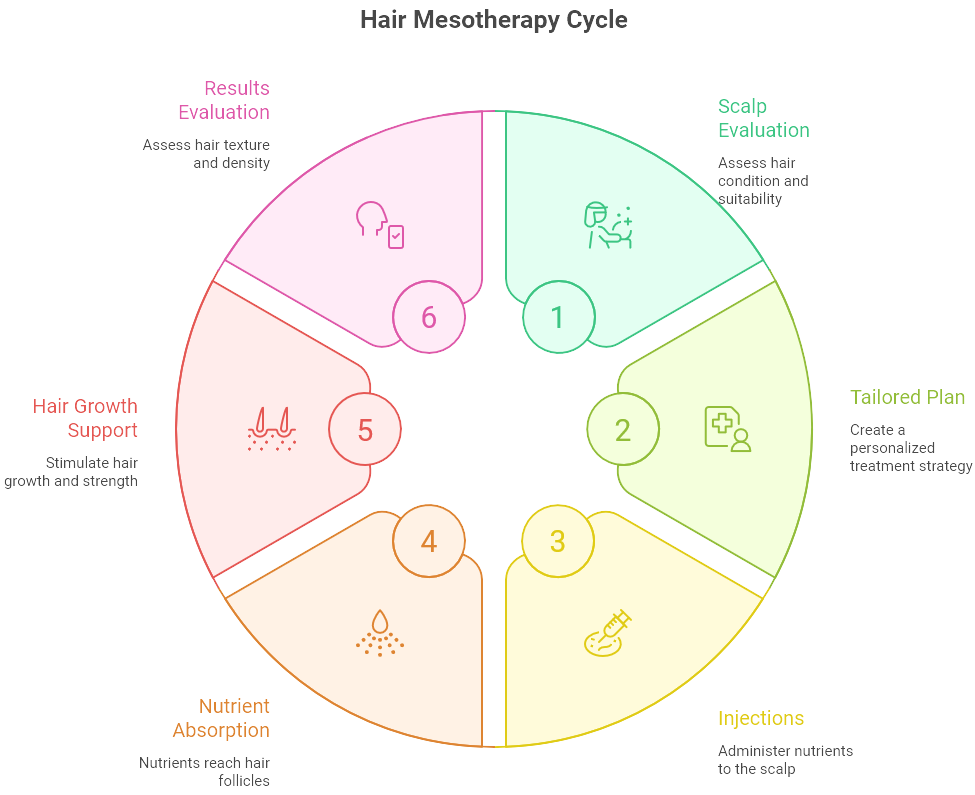
Before you start your treatment, you need to talk to a doctor for a scalp and hair evaluation to determine whether mesotherapy is appropriate. If yes, your doctor will create a tailored plan based on hair condition, medical history, and expectations.
During the procedure, small injections are administered across the scalp. The process is usually brief, and patient discomfort is very mild. Most patients tolerate it well without anesthesia.
After treatment, minor redness or sensitivity can appear at the injection sites. These side effects are typically temporary. You will find that they resolve themselves within a short period. In any case, patients can usually return to daily activities on the same day.
Your doctor will also probably recommend a course of multiple hair mesotherapy sessions. This suggestion aims to achieve optimal results, which is very difficult to achieve with a single treatment.
Who Should (and Shouldn’t) Get Hair Mesotherapy?
Hair mesotherapy is best suited for people in the early stages of hair thinning, experiencing stress-related shedding, or whose hair is weakened by hormonal changes. It can be helpful for patients who want non-surgical support or maintenance after other treatments.
However, mesotherapy is not ideal for individuals with advanced baldness where follicles are no longer active. In such cases, surgical restoration is a more appropriate option.
Whatever the case, a professional assessment is essential to determine suitability and realistic outcomes.
FAQs
Does hair mesotherapy hurt?
Most patients describe mild discomfort rather than pain. The patients’ pain sensitivity varies, but overall, the procedure is well tolerated.
Can mesotherapy replace a hair transplant?
No. Mesotherapy cannot replace a hair transplant in areas where hair follicles are permanently lost. It is used to support existing hair.
Can I combine mesotherapy with a hair transplant?
Yes. Mesotherapy is often used alongside surgical procedures to support healing, scalp health, and long-term hair quality.